Probabilistic vs. Deterministic Leak Testing: Where Does Uncertainty Live?
In the previous episode, we saw why dye can preserve evidence that bubbles lose in an instant. Now comes the distinction that is often oversimplified: probabilistic does not mean unreliable, and deterministic does not mean infallible.
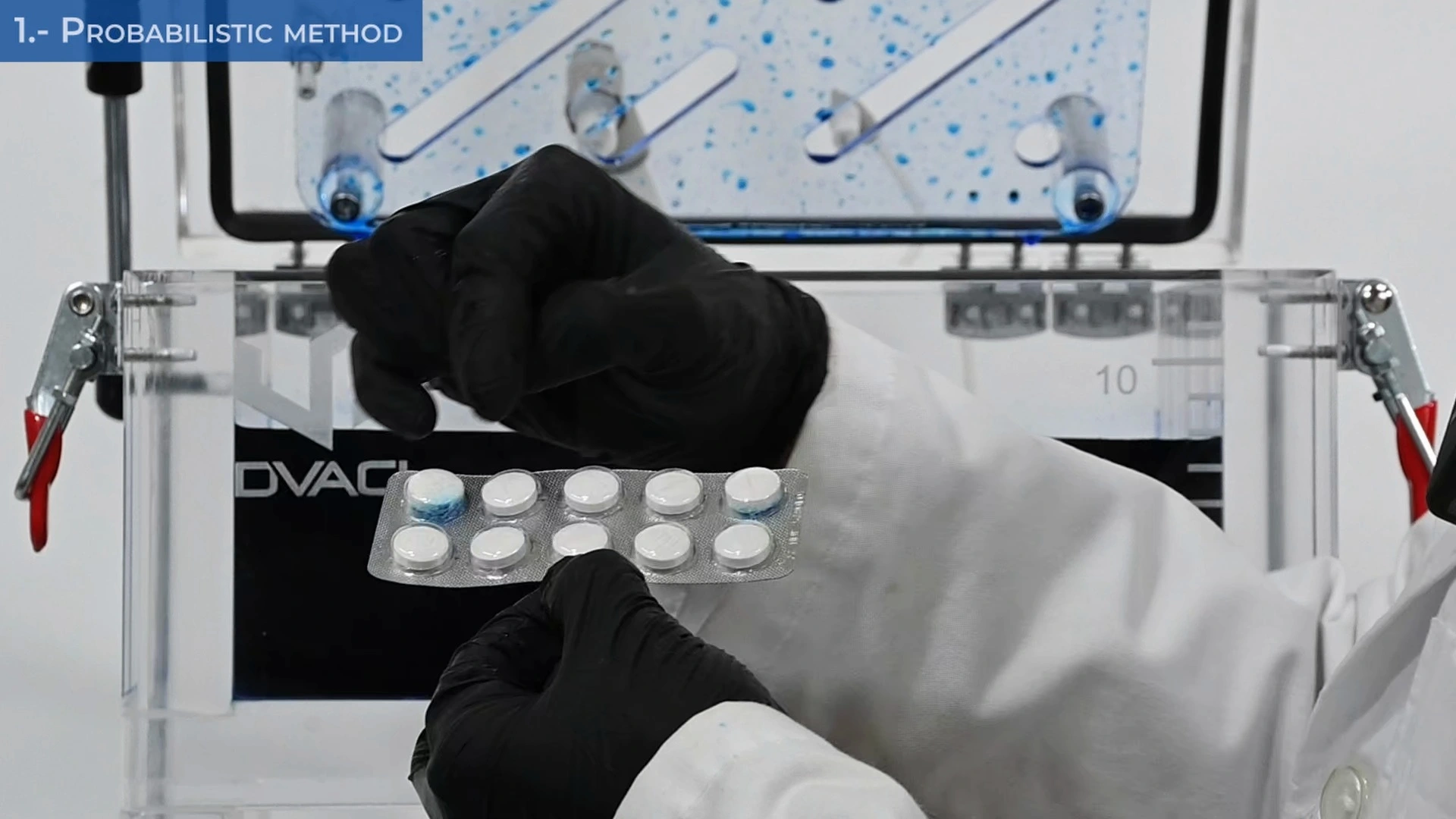
Probabilistic method
A dye ingress test depends on a sequence of events. The liquid must reach the defect, wet the channel, enter it, travel through it and accumulate in sufficient quantity to be seen.
- Wetting
- Entry
- Transport
- Visible dye
Deterministic method
A deterministic method measures a physical response, such as pressure decay, mass flow, tracer-gas concentration or electrical current, and compares it with a threshold.
- Signal
- Uncertainty
- Threshold
- Pass/Fail
The uncertainty lives at the margin.
A gross leak is detected consistently. A sound package should not produce a false alarm. The variability appears primarily in borderline defects near the method's detection limit.
Clear cases can be perfectly repeatable.
For marginal leaks, small variations in channel geometry, surface tension, liquid properties, pressure differential and inspection conditions can determine whether the dye becomes visible.
Dye immersion is also destructive. Probability of detection is therefore established across a population of comparable samples, not by repeatedly testing the same package.
What a deterministic method actually does
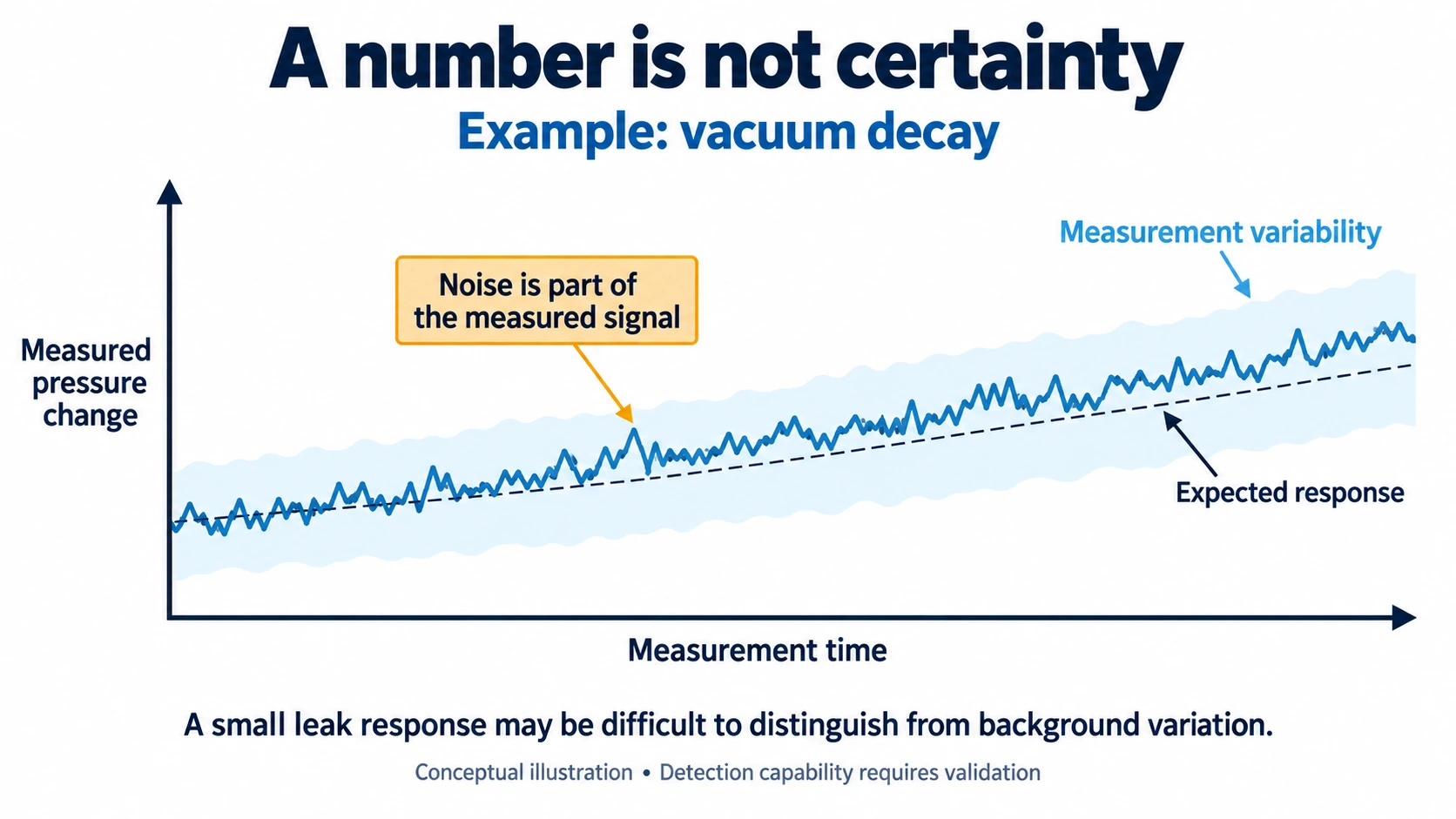
A number is not the same as certainty.
In vacuum decay, the instrument measures pressure over time. A small leak-related change may be difficult to distinguish from variation already present in that measurement. Package volume, test-system volume, outgassing, sensor stability and temperature can all affect detection capability.
The advantage is not the absence of uncertainty. It is the ability to characterize that uncertainty metrologically and reduce it through method development and control.
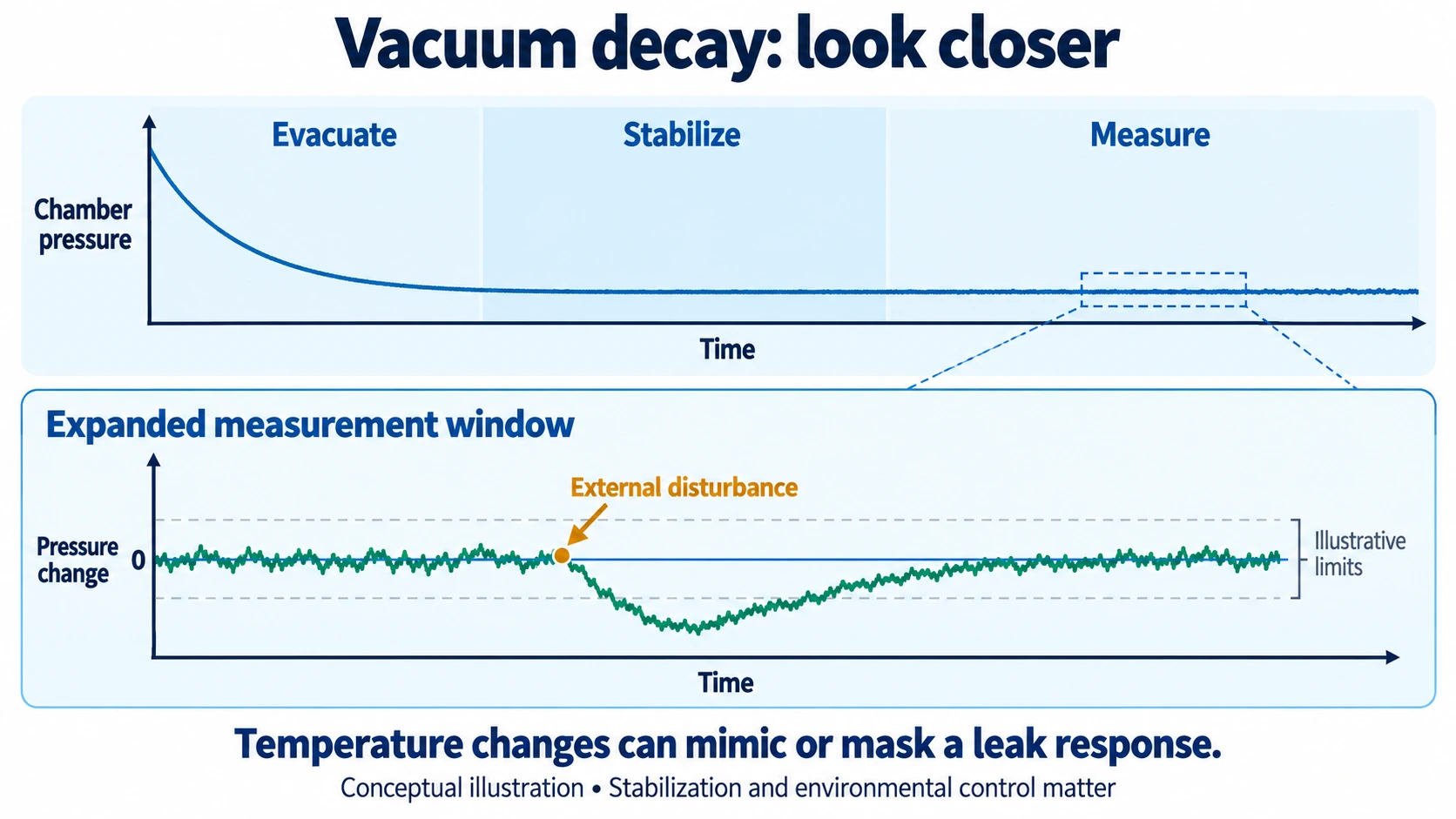
Vacuum decay can also drift near its limit.
Temperature changes and insufficient stabilization can create pressure variation that resembles, masks or modifies a small leak response. External disturbances can also produce transient excursions. These effects become clearer when the measurement window is viewed on an expanded pressure scale.
A preference — with conditions.
USP <1207> Package Integrity Evaluation—Sterile Products prefers deterministic methods when the other selection criteria permit. Method choice must still consider package design, product contents, the maximum allowable leakage limit, detection capability, test range and whether the sample must be preserved.
The correct question is not which label sounds more advanced. It is which validated method can address the relevant defect in the actual package and product.
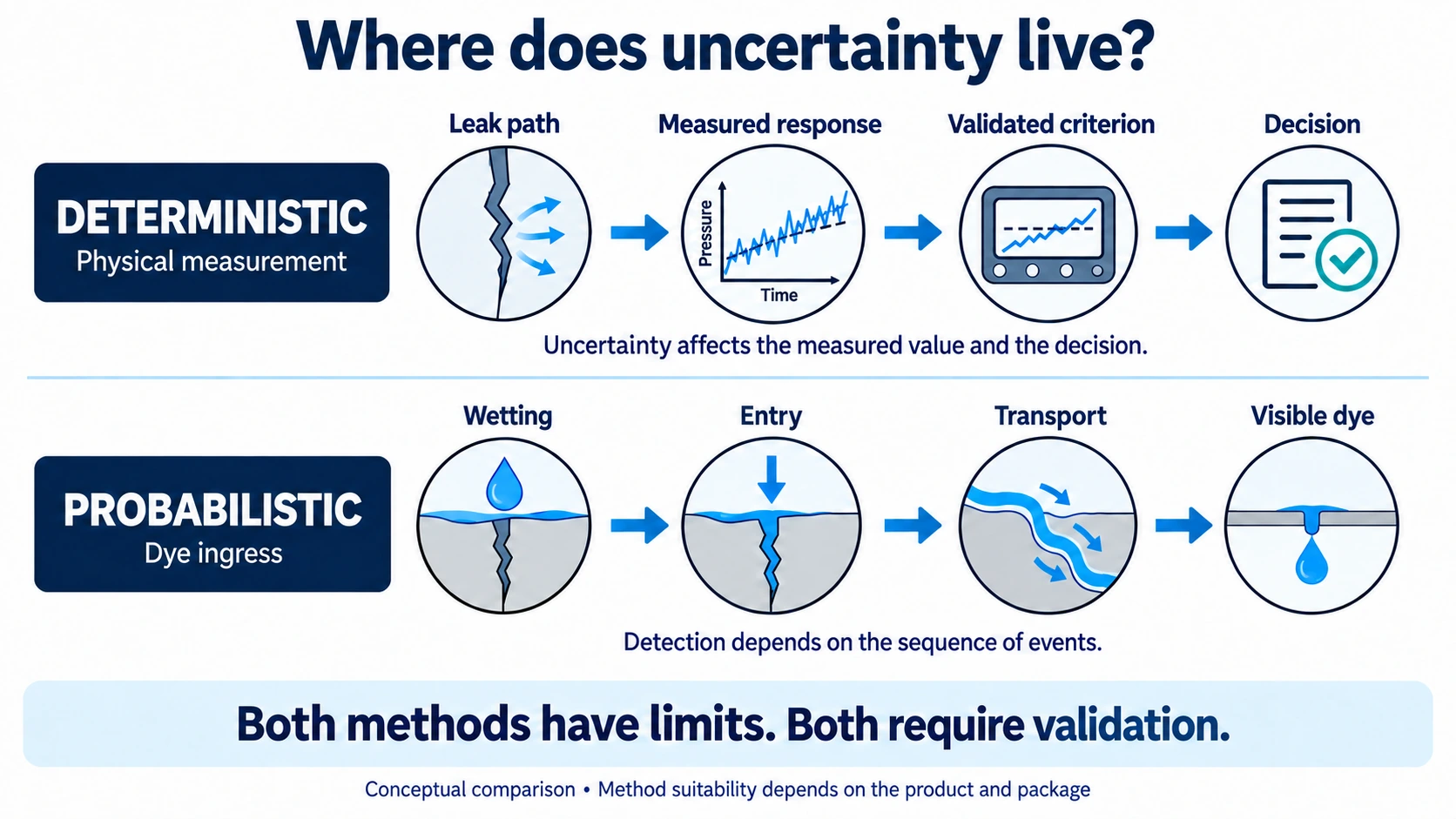
Both methods have a detection limit. Both wobble near it. What differs is where the uncertainty lives — and how you tame it.
If dye ingress has these limitations, why is it still used throughout the pharmaceutical industry and written into established procedures? Two practical reasons explain its staying power.