
ASTM D6653: High-Altitude Testing for Packaging Systems
Transportation by aircraft or across mountain routes can expose packaged products to lower atmospheric pressure. ASTM D6653/D6653M uses a vacuum chamber to reproduce that pressure differential and evaluate how the package and product respond.
atmospheric pressure
initial conditions
ASTM D6653 is an altitude-simulation method. It helps reveal whether a packaged product may leak, deform or become damaged when the pressure outside the package falls during transportation.
Why altitude creates stress on a package
A sealed or partially sealed package can retain pressure close to its original filling conditions. When external atmospheric pressure decreases, the difference between internal and external pressure can load seals, closures, walls and other package components.
The package begins at its initial pressure
The package is produced, filled or conditioned at a known or representative starting altitude.
External pressure decreases
Aircraft transportation or travel over high mountain passes can expose the package to lower atmospheric pressure.
The packaging system is stressed
The resulting pressure differential can contribute to leakage, seal failure, deformation or product loss.
Altitude, atmospheric pressure and chamber setting
The transportation profile is defined in altitude, but a vacuum chamber is set in pressure. The table below converts one into the other. The chamber setting is the pressure differential ΔP between sea level and the simulated altitude, which is exactly what a gauge reads as vacuum.
| Simulated altitude | Absolute pressure | Chamber setting (ΔP) | In inHg of vacuum |
|---|---|---|---|
| Sea level | 1,013 mbar | 0 | 0 |
| 3,281 ft (1,000 m) | 899 mbar | −114 mbar | 3.37 |
| 6,000 ft (1,829 m) | 812 mbar | −201 mbar | 5.93 |
| 8,000 ft (2,438 m) | 753 mbar | −260 mbar | 7.68 |
| 10,000 ft (3,048 m) | 697 mbar | −316 mbar | 9.33 |
| 14,000 ft (4,267 m) | 595 mbar | −418 mbar | 12.34 |
| 16,404 ft (5,000 m) | 540 mbar | −473 mbar | 13.97 |
Two cautions. These values come from the International Standard Atmosphere and assume the chamber sits at sea level. If your laboratory is at altitude, the local atmospheric pressure is already lower, so the same gauge setting no longer corresponds to the same simulated altitude — it must be recomputed from the pressure measured on site. Our pressure conversion guide explains the absolute and gauge scales and gives the altitude correction. The profile to apply always remains the one defined in your study and in the current standard.
Four packaging risks exposed by altitude
Liquid, powder, gas or aroma may escape if a closure or seal cannot withstand the differential pressure.
Stress can reveal weak seals, loose closures or components that separate under simulated altitude conditions.
Bottles, trays, pouches or other packages may expand, buckle or fail to return to their original shape.
Package movement or loss of containment may compromise the product or its presentation during distribution.
From transportation profile to post-test inspection
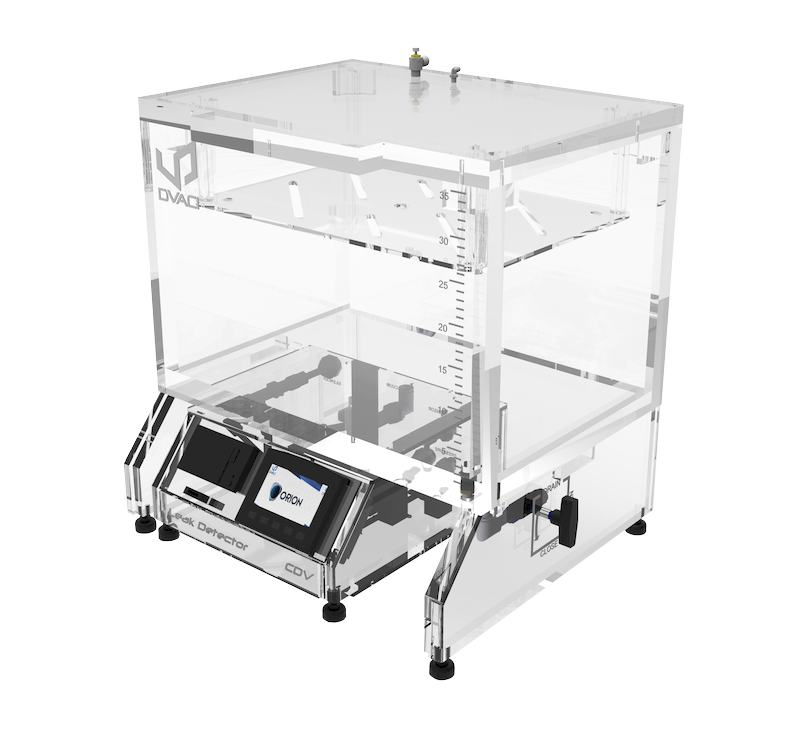
How ORION OS supports ASTM D6653 testing
ORION OS helps translate defined production and transportation altitudes into a controlled reduced-pressure test profile. This reduces manual calculation and makes repeated scenarios easier to reproduce.
- Pressure calculation based on the selected starting and destination altitudes.
- Controlled vacuum ramp, hold time and return sequence.
- Storage of up to 99 transportation profiles for recurring scenarios.
- Consistent recipes that support operator guidance and repeatability.
What should be examined after the cycle?
Acceptance criteria depend on the package, product and approved protocol. Observations should be documented against criteria established before testing.
Look for visible leakage, wet areas, loss of fill, closure movement or evidence of product escaping from the package.
Inspect for irreversible expansion, paneling, collapse, seal separation, closure displacement or other permanent damage.
A package can look acceptable and still have a leak path. If leak integrity must be confirmed, use a suitable separate leak test.
Practical value for package development and distribution
Identify altitude-related failure modes before products enter a demanding distribution route.
Compare materials, closures, seals and configurations under representative pressure stress.
Finding weaknesses before shipment can reduce damaged goods, returns and investigation costs.
A defined profile and acceptance criteria provide clearer evidence for engineering and quality teams.
Altitude simulation and leak detection are related—but not identical
ASTM D6653 altitude simulation
Evaluates how a packaged product responds to the pressure differential associated with high-altitude transport. The standard describes the results as qualitative.
A separate package leak test
Targets the presence of a leak using an appropriate method and defined detection capability, such as ASTM D3078 vacuum leak testing or a water-bath bubble leak test. It may be needed before or after altitude exposure when integrity confirmation is part of the objective.
Frequently Asked Questions about ASTM D6653
What is ASTM D6653 used for?
It is used to evaluate the effects of the pressure differential that packaged products may experience during air transportation or ground transportation over high mountain passes.
Is ASTM D6653 a leak test?
It can reveal visible leakage or package failure caused by altitude exposure, but its primary purpose is altitude simulation and qualitative evaluation. A separate leak test may be appropriate when package integrity must be confirmed.
What packages can be tested?
The method can be applied to packaged products whose performance may be affected by reduced external pressure. Chamber size, package geometry, contents and the intended transportation profile must be considered when selecting the setup.
How is high altitude simulated in a vacuum chamber?
The chamber pressure is reduced to reproduce the lower atmospheric pressure associated with the selected altitude. The package experiences a pressure differential similar to the defined transportation condition.
Can ORION OS store different transportation scenarios?
Yes. ORION OS can store up to 99 transportation profiles, allowing recurring altitude scenarios to be selected and repeated more consistently.
Need to reproduce a transportation altitude profile?
Share your package dimensions, product type, starting altitude and expected transportation conditions. DVACI can help you evaluate a suitable chamber and test configuration.